• Word Café
  • Writers/Teachers
    • Nina Shengold “Opening Lines” 9/17/16
    • Jana Martin, “The Last Line” 10/8/16
    • Abigail Thomas & Pauline Uchmanowicz 9/25/16
    • Amitava Kumar & Sunil Yapa 10/23/16
    • Nina Shengold & Jana Martin 12/4/16
  • Schedule + Registration
  • Event Archive
  • Contact

Word Café

a master class for readers and writers

AMITAVA KUMAR, “Location, Location”

October 2, 2014 By Word Cafe

AMITAVA KUMAR is a writer and journalist. He was born in Ara, India, and grew up in the nearby town of Patna, famous for its corruption, crushing poverty and delicious mangoes. Kumar is the author of several books of non-fiction (A Matter of Rats, A Foreigner Carrying in the Crook of His Arm a Tiny Bomb, Husband of a Fanatic, Bombay-London-New York, Passport Photos) and a novel (Nobody Does the Right Thing, also published as Home Products). A Foreigner Carrying in the Crook of His Arm a Tiny Bomb was adjudged the best nonfiction book of the year by the Page Turner Awards in 2011; in 2007, Home Products was short-listed for India’s premier literary award, the Crossword Award; Husband of a Fanatic was an “Editors’ Choice” book at the New York Times. In 2015, a collection of essays entitled Lunch With A Bigot will be published by Duke University Press. He lives in Poughkeepsie, where he is Helen D. Lockwood Professor of English at Vassar College.

Read Nina Shengold’s Chronogram profile.

“Location, Location” 10/2/14 – The Exercises

Our topic on October 2 was “Location, Location.” Vassar professor and multigenre writer Amitava Kumar delighted a rapt audience by reading several passages from his book A Matter of Rats, sprinkling in stories about how he constructed this short biography of his hometown, Patna, India.
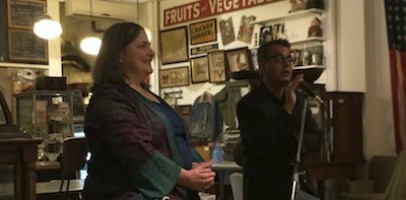
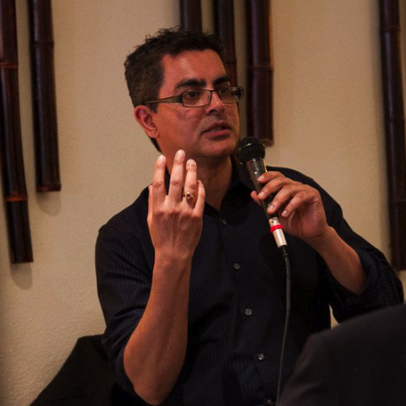
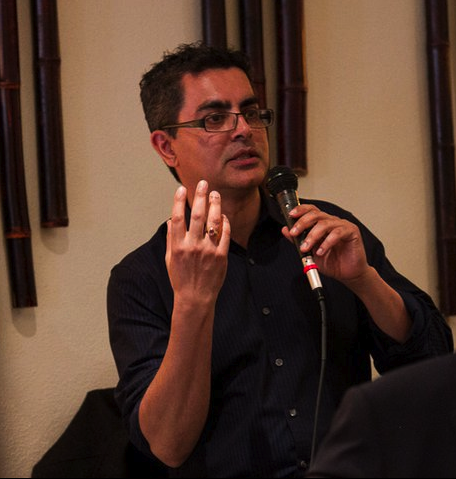
Amitava Kumar lecturing at Word Café
Amitava Kumar
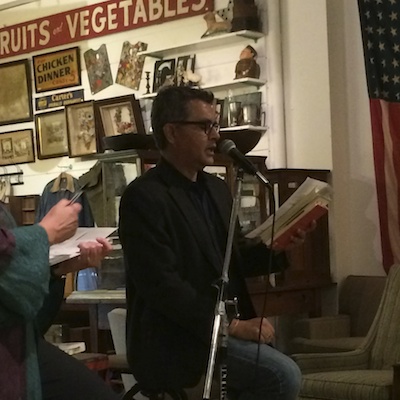
Amitava Kumar reads a passage from his book, A Matter of Rats.
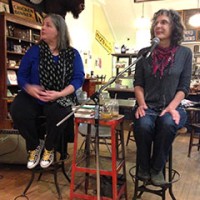
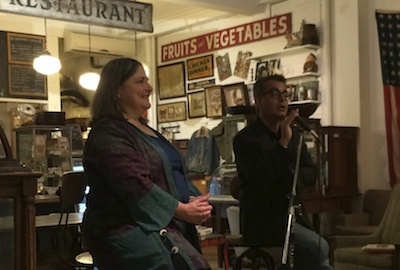
Nina Shengold and Amitava Kumar
Nina & Amitava
Nina Shengold and Amitava Kumar on "Location, Location"
Amitava Kumar
Amitava Kumar
Amitava Kumar talks to a rapt audience of writers.


Amitava passed out a page with 11 brief writings by Arundhati Roy, Jonathan Franzen, David Foster Wallace, David Wojnarowicz, Denis Johnson, Amy Hempel, J.M. Coetzee, Lydia Davis, Joan Didion, and Ismat Chughtai. Volunteers read several of these aloud, and we had a lively discussion about the specific choices and details that bring them to life.

Nina quoted an essay by Nancy Willard, recounting a game she’d played with her sister in which one girl would close her eyes as the other described a place, adding details until the listener cried out, “I’m there!”

We talked about using a concrete detail to anchor a fictional description of a place you’ve never been, or asking someone who does live there to vet the details; James Joyce sent his sister to check on things while writing about Dublin from Paris. It’s often easier to write about a place you remember than one where you’re living now, because memory distills it to essentials. Amitava likened this to the difference between the depth of field of an iPhone camera, which renders everything in a photo in focus, and a professional SLR camera, which can be focused selectively so that one object is sharp and others are blurred or pushed into the shadows.

  1. Amitava read a passage from Joseph O’Neill’s Netherland including a phrase about “Poughkeepsie, a merry name that sounds like children crying out in a game.” He asked each of us to consider the sound and feel of our hometown’s name and write a sentence or two connecting that name to the place. (The ones people read were wonderful!)
  2. Another exercise from Amitava: Describe what can you see outside the window closest to where you write.
  3. Click to open Amitava Kumar’s handout.
  4. From Nina: Write a detailed description of leaving home for a place you (or your character, if you’re writing fiction) have never gone before. Part two: write about arriving in that new place, using all five senses.

Amitava recommended a daily practice of writing a small, achievable amount, citing “as much as it takes to cover a Post-It” from Anne Lamott’s Bird By Bird. He sets his students a mantra: “Write every day and walk every day.” 150 words and ten minutes of mindful walking. It all adds up.
BEVERLY DONOFRIO, “The Telling Detail”

September 25, 2014 By Word Cafe

BEVERLY DONOFRIO‘s first memoir, Riding in Cars with Boys, has been translated into sixteen languages and transformed into a popular motion picture. Her second memoir, Looking for Mary (or, the Blessed Mother and Me), began as a documentary on NPR and was chosen as a Discover Book at Barnes & Noble. She is the author of two picture books illustrated by Barbara McClintock, and a book for middle-graders. Beverly is an award–winning radio documentarian and essayist and can be heard on All Things Considered. Her personal essays have appeared in the New York Times, Washington Post, Los Angeles Times, Allure, Cosmopolitan, New York Magazine, The Village Voice, O, Marie Claire, and Spirituality & Health. She lived for four years as a lay Carmelite at Nada Hermitage in Colorado, where she began her new memoir, Astonished, published by Viking in 2013. Beverly lives in Woodstock, and teaches at the low residency MFA program at Wilkes University.

Read Nina Shengold’s Chronogram profile.

“The Telling Detail” 9/25/14 – The Exercises

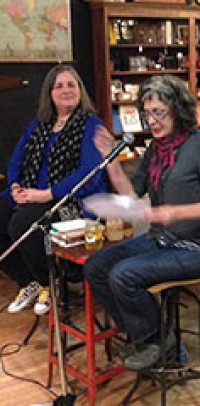
Beverly Donofrio delighted the Word Café crowd by reading an exuberant new piece called “Anthem” which she’d just written in a TMI workshop.
 

Nina Shengold and Bev Donofrio
Nina and Bev
Bev Donofrio in action at Word Café. You can tell what a wonderful reading she gave--the manuscript pages are vibrating!
Beverly Donofrio and class
Bev Donofrio's
workshop
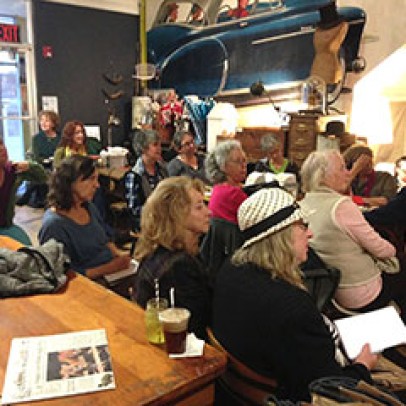
Another full house at Word Café with Bev Donofrio
Nina Shengold and Bev Donofrio
Nina and Bev
Fielding questions from the group

 
Our subject was “The Telling Detail,” and we talked the way in which a carefully chosen detail can paint the whole picture.

Bev said that though many writers spill out a lot in the first draft and then cut, she tends to write short and then fill in more and more detail. But rewriting can also be a winnowing process. She described a short chapter in Astonished about a bunny, which started out with a lot of step by step detail. Something about it didn’t feel right, and she set it aside for awhile. (Her process includes a lot of stopping, walking away to do other things, and starting again–what she cheerfully called “ADD.”) When she reread it, she realized the story she wanted to tell began midway through her draft, and cut nearly half of the chapter.

Asked if there’s such a thing as too much detail, Bev asserted that if you’re really passionate about something and every detail excites you, the reader will share your excitement.

She also said that the most important thing about writing memoir is “being absolutely and completely who you are.” Writing “is not therapy, but it is therapeutic,” and telling the truth about difficult things is cathartic.

Here are the writing prompts we gave in class, all of which inspired wonderful work from participants:

  1. Bev read a short passage from Margaux Fragoso’s memoir Tiger, Tiger written in third person sentences which all begin, “Picture a girl who…” Write a series of sentences beginning with “Picture a girl (or boy) who…,” revealing how you became something you still are today.
  2. Write about a moment when everything changed, an event that divided your life into a “before” and “after.” (Bev)
  3. Nina’s exercise borrowed a two-step process from Mark Wunderlich’s word-list poems. Describe a significant room from your past in as much detail as possible: list everything in it, sounds, smells, textures. Then go back over this list and circle three details that gave the room its characteristic feel and atmosphere.

MARK WUNDERLICH, “Rhythm & Image”

September 18, 2014 By Word Cafe

MARK WUNDERLICH was born in Winona, Minnesota and grew up in rural Fountain City, Wisconsin. His first book, The Anchorage, was published in 1999 by the University of Massachusetts Press, and received the Lambda Literary Award. Voluntary Servitude was published in 2004 and The Earth Avails, both by Graywolf. He has published poems in The Paris Review, Yale Review, Slate, Tin House, Poetry, Ploughshares, Boston Review and elsewhere. His work has been included in over thirty anthologies and has been featured on NPR’s All Things Considered. His work has been translated into Italian, Bulgarian and Swedish. Wunderlich has taught in the graduate writing programs at Columbia University, Sarah Lawrence College, Ohio University and San Francisco State University. He has taught undergraduate writing and literature courses at Stanford University, Barnard College and Stonehill College. Since 2003 he has been a member of the Literature Faculty at Bennington College in Vermont. Wunderlich lives in New York’s Hudson Valley near the village of Catskill.

Read Nina Shengold’s Chronogram profile.

“Rhythm & Image” 9/18/14 – The Exercises

At our third class, the delightful Mark Wunderlich read four poems from The Earth Avails (Graywolf, 2014) and a new poem he wrote this summer. He talked about his writing process (it involves a lot of getting up and washing dishes, going back to work, splitting kindling, going back to work) and how poetry involves breath and music. “Whenever we speak, we’re singing to each other.”

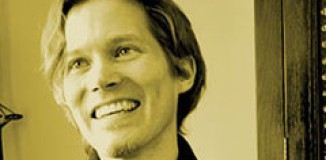
mark wunderlich
mark wunderlich

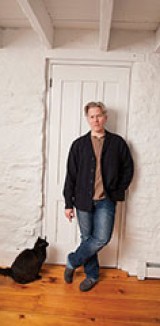
Mark Wunderlich

mark wunderlich

Mark Wunderlich


It’s also a visual form. Mark pointed out that prose is fluid, flowing from margin to margin, where poetic lines are specific. They don’t “break” so much as “breathe.”

MARK’S EXERCISE:

Imagine a place from your past and spend five minutes listing favorite words you associate with it. (Examples from his family farm: muskrat/chokecherry/milk pail.) Don’t overthink or censor yourself. Keep your pen moving constantly. If you can’t think of the next word, keep writing the same one till a new one comes to you.

Choose ten favorite words from this list and print them on a separate sheet of paper.

Now trade pages with someone you don’t know. You have ten minutes to write a poem using all ten of the words you’ve been given. Go.

NINA’S EXERCISE:

Describe something you find beautiful in as much detail as you can, without using any adverbs or adjectives. (Examples: it can’t be “big,” but it can dominate the room. It can’t be “green,” but it can smell like pine.) Ten minutes.

Both exercises impose limitations (time limit, rules about what words you must or can’t use). Mark observed that writers can become overly invested in producing a product–a finished thing–and lose their sense of playfulness, invention, and accident. “All of poetry is a conversation between freedom and restraint,” he said. “When you engage the good soldier with rules and patterns, the reptile part–the id, the wild woman–gets to come out and do its thing.”

He also proposed some uses for “those little notebooks people always give you as gifts when they know you’re a writer”:

— A book of possible titles

— A book of quotations and overheard dialogue

— A “good lines” box for things you wind up cutting: Recycle your darlings.

If you can’t clear the decks to give yourself uninterrupted blocks of writing time, you can always find 20 minutes to check in with your creative work. Make lists, do exercises, get something started.

« Previous Page
Next Page »

Upcoming Events

There are no upcoming events.

View Calendar
Add
  • Add to Timely Calendar
  • Add to Google
  • Add to Outlook
  • Add to Apple Calendar
  • Add to other calendar
  • Export to XML

EVENT ARCHIVES

see-whos-been-here-so-far-word-cafe

See who’s been here so far

applause-word-cafe

Word Cafe Salon 12/3/15

nina-shengold-jenny-milchman-jeffrey-davis

Jenny Milchman + Jeffrey Davis “Inspiration”

sponsored by

The Golden Notebook Bookstore _Chronogram Logo

© 2021 Word Café + Nina Shengold · Site by Nan Tepper Design