• Word Café
  • Writers/Teachers
    • Nina Shengold “Opening Lines” 9/17/16
    • Jana Martin, “The Last Line” 10/8/16
    • Abigail Thomas & Pauline Uchmanowicz 9/25/16
    • Amitava Kumar & Sunil Yapa 10/23/16
    • Nina Shengold & Jana Martin 12/4/16
  • Schedule + Registration
  • Event Archive
  • Contact

Word Café

a master class for readers and writers

JANA MARTIN & GREG OLEAR, “True Fiction”

October 23, 2014 By Word Cafe

jana martinJANA MARTIN received an MFA from the University of Arizona, where she has also taught fiction writing. Her highly praised debut collection Russian Lover and Other Stories is published by Yeti Press. Her story “Hope” won a Glimmer Train Short Story Award for New Writers. Her stories and nonfiction have appeared in Five Points, Spork, Yeti, the Village Voice, Cosmopolitan, and Willow Springs. A veteran of numerous downtown bands including the Campfire Girls, Jana lives in Olivebridge with a large number of dogs, chickens, and pigeons, and is currently writing a novel.


greg olear
GREG OLEAR (OH-lee-ar) is the founding editor of The Weeklings and the author of the novels Totally Killer and Fathermucker, a Los Angeles Times bestseller. He was Senior Editor of The Nervous Breakdown, and his writing has appeared in The Beautiful Anthology (TNB, 2012), at Babble.com, The Huffington Post, The Rumpus, The Millions, Hudson Valley Magazine, and Chronogram. He has taught creative writing at Manhattanville College, and lives with his family in New Paltz, where Fathermucker is set.

Read Nina Shengold’s Chronogram profile.

“True Fiction” – 10/23/14 – The Exercises

Fiction writers, essayists, and The Weeklings editors Greg Olear and Jana Martin delighted a packed house with readings of Jana’s story “Goodbye John Denver” (from her collection The Russian Lover and Other Stories) and a sneak peek at Greg’s new novel-in-progress (following in the great footsteps of Fathermucker and Totally Killer).
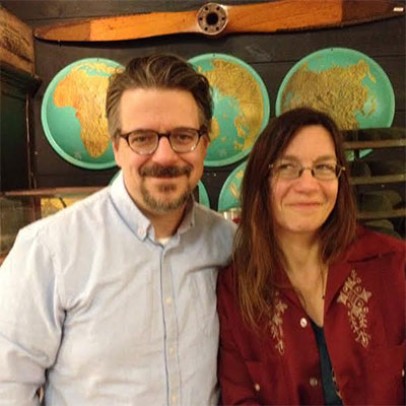
Jana Martin and Greg Olear
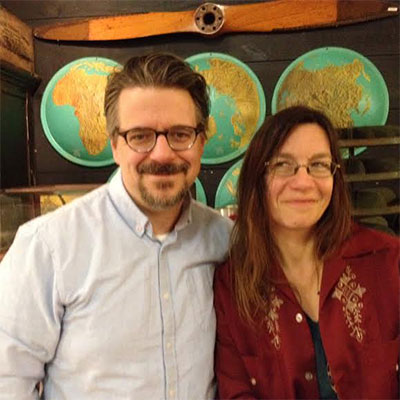
Jana & Greg

Jana Martin & Greg Olear

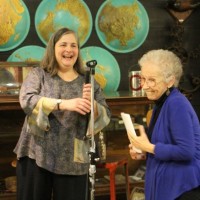
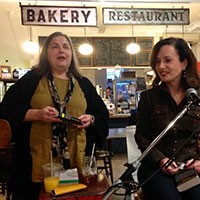
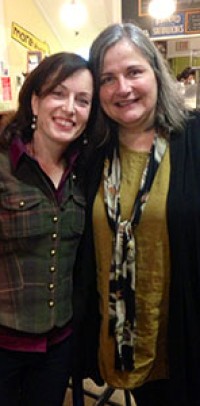
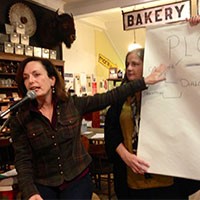
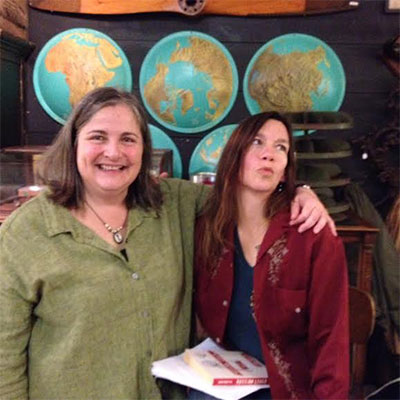
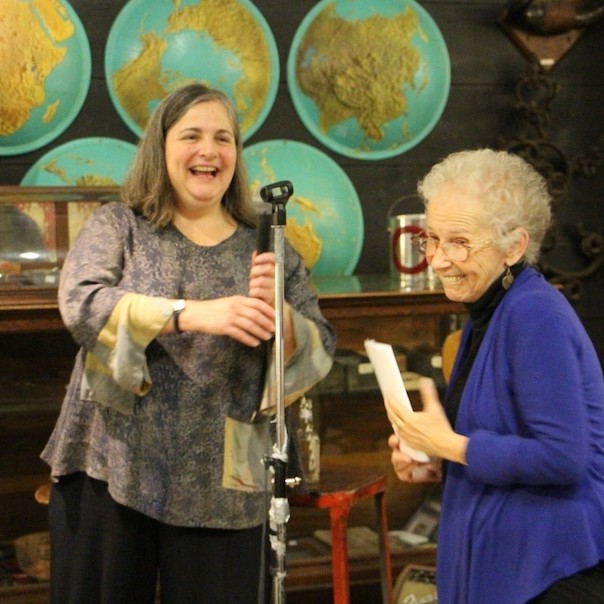
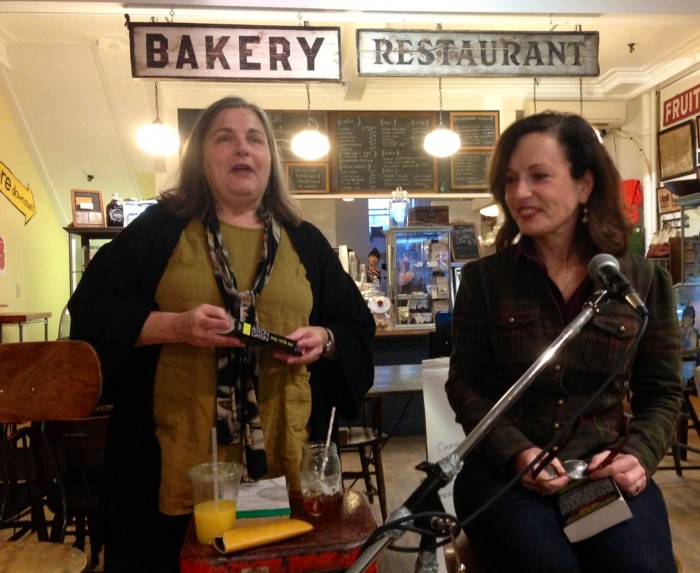
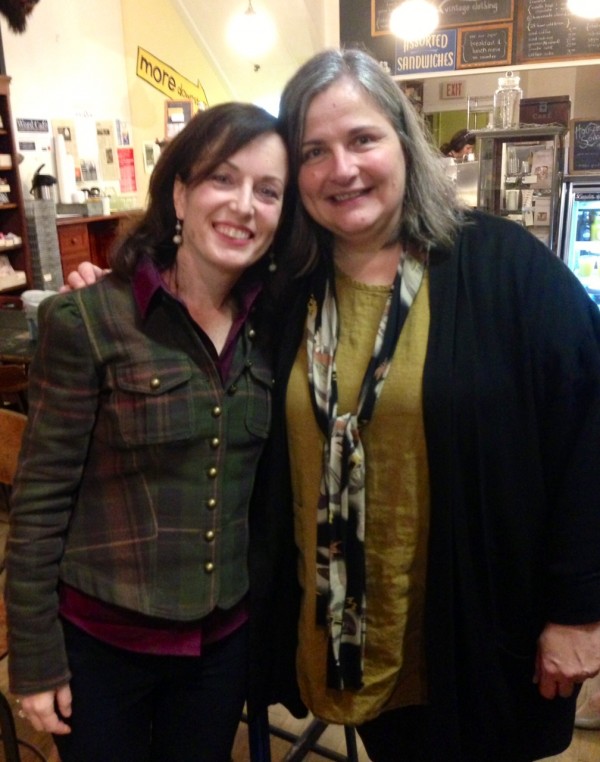
Nina Shengold and Jana Martin
Nina Shengold & Jana Martin

Nina and Jana

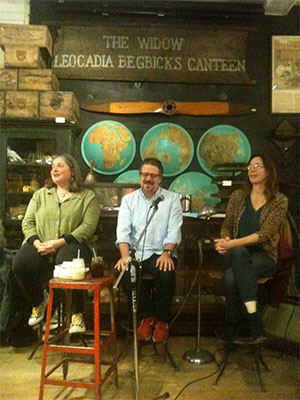
Nina Shengold, Greg Olear & Jana Martin
Nina, Greg & Jana
Nina, Greg & Jana

 
Our topic was “True Fiction,” which Nina described as fiction that starts with one foot in the truth. Instead of recording what actually happened, the writer asks the question, “What could have happened?” or “What if…?”

Jana said she writes essays and fiction “with two entirely different hands,” and that for her, fiction “comes from a place of yearning.” Greg talked about fiction’s slower pace and “longer shelf life,” saying that if he has an immediate response to something in the culture, it’s an essay. If it requires longer to write, and will last longer, it’s fiction.

Both writers have set stories and novels in places they’ve lived; Fathermucker is set in a pitch-perfect New Paltz, and many of Jana’s stories take place in parts of the country where she’s lived or traveled. Greg commented that he often writes something set in a location from his past while he’s living somewhere else, and finds that distance helpful. Nina sometimes fictionalizes the name of a town, but surrounds it with actual places from the same region. This can give you a strong sense of place without having to adhere to a rigid street map.

All agreed that if you’re using a real location (especially a familiar one, like midtown Manhattan), it’s important to get the details right, but several participants pointed out that too much research can be off-putting, cluttering the text with what Ed McCann called “Wikipedia moments.”

We also talked about modeling fictional characters on actual people. Jana suggested disguising specifics, but basing the character on the truth of a person. At some point, she said, “The character owns you. Fiction allows characters to swell outside their outlines.” Greg added that writers have no idea how people will respond to seeing a character based (even in part) on themselves–sometimes the person you’ve flattered gets offended, and the one you’ve made into a villain is delighted. He quoted Faulkner’s dictum that “if a writer has to rob his mother, he will not hesitate; the “Ode on a Grecian Urn” is worth any number of old ladies.”

GREG’S EXERCISE:

Write a paragraph from the point of view of a character returning to the hometown he or she loved. Now write a paragraph from the point of view of a person returning to the hometown he or she did not love.

JANA’S EXERCISE:

Write a scene in first person, present tense about an extremely uncomfortable encounter with a second character (characters can be real or invented). How does it feel to be in proximity with that other person? What happens?

NINA’S EXERCISE:

Write a seven-sentence narrative in which the first sentence is entirely true, and the seventh is entirely fictional.   The shift from truth to fiction can come at any point between, in small increments or with one bold decision. Can the reader guess where the changeover happened?
LAURA SHAINE CUNNINGHAM, “Character Studies”

October 16, 2014 By Word Cafe

LAURA SHAINE CUNNINGHAM is the author of two acclaimed memoirs, Sleeping Arrangements and A Place in the Country, which were first published in the New Yorker and went on to become bestsellers. She is also the author of six novels, including Beautiful Bodies and Dreams of Rescue. Her plays are published by Broadway Play Publishing and have been produced by Steppenwolf Theater, in New York City, and in Russia, Romania, Croatia, Finland, Portugal, England, and Mexico. She is an alumna of New Dramatists and a playwright member of The Actors Studio and Herbert Berghof Theatres. Laura is a frequent contributor to The New York Times and her work has appeared in The Atlantic Monthly, Esquire, the New Yorker, Harper’s Bazaar, and Vogue. She’s taught creative writing at Muhlenberg College and the Hudson Valley Writers Center, and was recently a keynote speaker at Marist College.

Read Nina Shengold’s Chronogram profile.

“Character Studies” 10/16/14 – The Exercises

This week’s subject: “Character Studies.” The ebullient Laura Shaine Cunningham read a passage from her memoir Sleeping Arrangements about her childhood friend Diana, “a dirty blonde in every sense.” Then she treated us to a guest appearance by the equally delightful Laura Rose, who read excerpts from her just-published The Passion of Marie Romanov, #1 Amazon bestseller in Russian History.

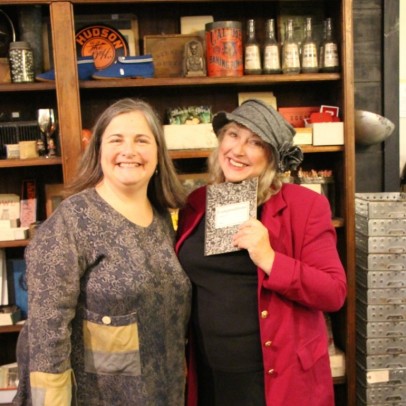
Nina and Laura Shaine Cunningham
Nina and Laura
Nina Shengold and Laura Shaine Cunningham
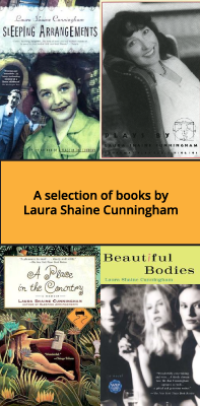
laura-books
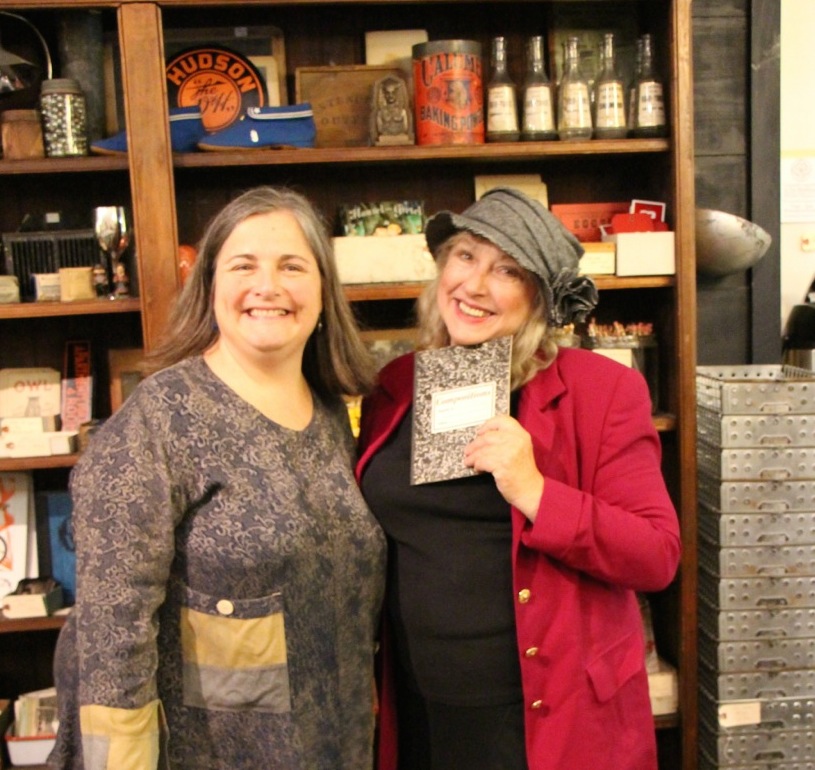
nina and guest
Nina and guest
Nina and workshop participant
The audience
The audience

We had a lively discussion about writing unforgettable characters in memoir and fiction. Some insights from Laura Shaine Cunningham:

“Actions speak louder than words. So do your senses.” She provided some wonderful sample sentences:

SIGHT: “She was a flash of silver glitter pasted over a total torso tattoo, and moved her buttocks independently of the rest of her body, so fast they blurred. “That’s my big booty dance; I came by it naturally…”

SCENT: “I could smell her before she even entered the room. Patchouli. I was almost unconscious when she appeared, looking quite the way she smelled: a harem dancer, with Theda Bara bangs and a scarlet smile.”

SOUND: “She was cracking gum between her words, and I could hear that snap, with an occasional juicy swoosh, as she suggested, “I could meet you after…”

TASTE: “She must have been swimming in the sea and not had time to shower. Her full mouth seemed to be encrusted lightly, like a fine piece of fish.”

Laura also observed that the people you write about are those who have an impact on you, and that her fictional characters are often a mix-and-match composite inspired by physical and behavioral specifics of people she’s known or observed.

She reminded us of the fearlessness of children’s imaginations, and the joy that comes from writing. “Don’t be scared of writing. It’s life that’s scary.” Writing can offer escape and catharsis. Laura’s pamphlet about writing memoir, Write For Your Life, is available through her Memoir Institute, which also offers full editing services as well as publishing under the imprint Memoir House. info@memoirinstitute.org

LAURA’S CHARACTER EXERCISE:
Give one character an action that defines her, using the senses. Now add a second character, and have their interaction define them both. See how high you can go with the number of characters and actions.

NINA’S CHARACTER EXERCISE:
Think of your most eccentric relative, and write a scene in which that person gets a new pair of shoes. Invent the character of the salesperson. How do they interact?

ALISON GAYLIN, “The Plot Thickens”

October 9, 2014 By Word Cafe

ALISON GAYLIN‘s debut book Hide Your Eyes was nominated for an Edgar Award in the Best First Novel category. Her critically acclaimed suspense novels have been published in such countries as the UK, France, Germany, The Netherlands, Norway and Japan. She has been nominated for the ITW Thriller, Anthony and RT Awards and won the Shamus Award for And She Was, the first book in the Brenna Spector series. Her books have been on bestseller lists in the US and Germany. She is currently at work on her ninth book, a standalone suspense novel entitled What Remains of Me, which will be released in 2015 from HarperCollins. She lives in Woodstock with her family.

“The Plot Thickens” 10/9/14 – The Exercises

nina-and-alison
Nina and Alison
Nina and Alison discussed plot development.
alison-and-nina
Alison Gaylin
with Nina Shengold
Alison Gaylin and Nina Shengold
alison-gaylin-teaching
Alison Gaylin
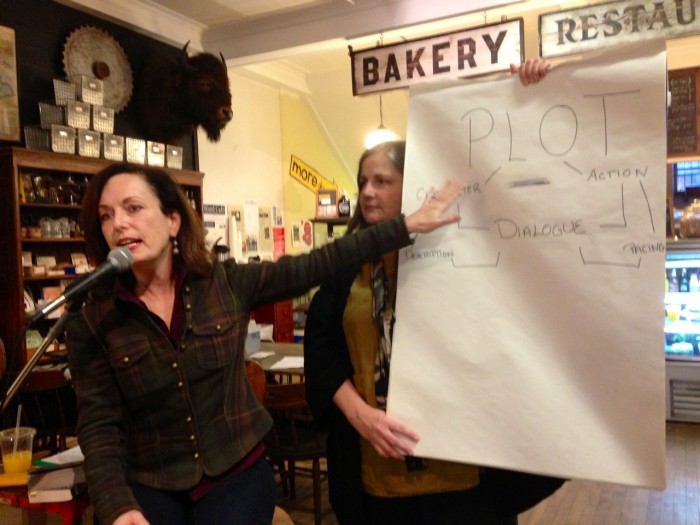
Alison Gaylin describes developing a plot.


Alison Gaylin treated us to a galvanizing reading of the prologue to her latest Brenna Spector mystery, Stay With Me.

Our theme was “The Plot Thickens”–how to build conflict and suspense–and Alison’s reading exemplified the chart she displayed, with PLOT “at the top of the food chain,” right above CHARACTER and ACTION (connected to each other by DIALOGUE, with DESCRIPTION and PACING feeding both). Some plot tips from Alison:

— Start in mid-scene, with something important about to happen
— The more urgent a character’s need, the more compelling the story becomes
— If two characters’ needs are at cross-purposes, conflict builds naturally
— If one character needs information from another, give then an opinion about each other to animate the scene. The waitress is irritated by the cop who’s questioning her, the cop is attracted to her, etc.

Even though plot is king, you do not need to have the whole story in view when you start your first draft. Alison cited E.L.Doctorow’s analogy of driving at night, only able to see as far as the headlights reach. She likes to have a sense of where she’s headed (“I’m heading for LA, but I may take a northern rather than a southern route, or wind up in San Francisco instead of LA. But I know I’m heading west.”) If you get lost along the way, go back and see what you have so far. Often you’ve instinctively included a character or incident you can make use of later.

Rewriting involves ruthless cutting. If it doesn’t move the plot forward, it goes into the discard file. (Note it’s not deleted, but saved in a separate file, because it might be useful later, or in something else.)

When Alison was starting out, she didn’t feel she was as good as plot as characters and dialogue, so read 100 crime novels of all kinds–Dostoevsky to James M. Cain, Elmore Leonard, and Laura Lippmann–to study how they worked.

Nina offered a redux of the three-act “story arc” in screenwriting:
Act One: Character gets up a tree (i.e. start on the day something changes)
Act Two: People throw rocks at him (i.e. obstacles he must face)
Act Three: He gets down on the other side (i.e. changed by the journey)

Alison says she writes for the pleasure of being scared. “If I scare myself, I’ll scare the reader.”

The best villains have unexpected good qualities, and the best heroes have flaws and weaknesses. This shadow side will create a three-dimensional character.

ALISON’S EXERCISE:
Think of the most heinous action you can imagine (but something you want to write about). Now think of the most noble action. Write a scene in which your character is doing one of these two actions, and the other is in that character’s past and comes into play in the current scene.

NINA’S EXERCISE:
Your character boards a train at the last minute and rushes into an empty seat, sitting on a discarded newspaper. Then realizes there’s something underneath it. What is it, and what does the character do?

« Previous Page
Next Page »

Upcoming Events

There are no upcoming events.

View Calendar
Add
  • Add to Timely Calendar
  • Add to Google
  • Add to Outlook
  • Add to Apple Calendar
  • Add to other calendar
  • Export to XML

EVENT ARCHIVES

see-whos-been-here-so-far-word-cafe

See who’s been here so far

applause-word-cafe

Word Cafe Salon 12/3/15

nina-shengold-jenny-milchman-jeffrey-davis

Jenny Milchman + Jeffrey Davis “Inspiration”

sponsored by

The Golden Notebook Bookstore _Chronogram Logo

© 2021 Word Café + Nina Shengold · Site by Nan Tepper Design